Visar inlägg med etikett archiving. Visa alla inlägg

lördag 2 juli 2016

Why archaeologists are so keen on reports and not on research data?

Isto discusses in a newly published article what hinders the archiving and use of archaeological primary data, and why reports, which according to many contain insufficient information, are popular among archaeologists.

Huvila, I. (2016). Awkwardness of becoming a boundary object: Mangle and materialities of reports, documentation data and the archaeological work. The Information Society, 32(4), 280-297.

Abstract: Information about an archaeological investigation is documented in an archaeological report, which makes it the boundary object par excellence for archaeological information work across stakeholder communities such as field archaeologists, heritage managers, and land developers. The quality of reports has been a subject of debate, and recently it has been argued that more emphasis should be placed on making primary research data at least similarly available. This study explores the changing materialities and reciprocal formation of documents and their users with the advent of digitization, and how documents form and lose their status as boundary objects in these processes. The study posits that in order to be functional, a boundary object needs to provide a disclosure that makes it accessible to cognate communities. Further, it shows how assumptions about the functioning of the human and nonhuman (material artifacts) influence the ways in which archaeologists conceptualize the preservation and archiving of archaeological information and the role and potential of different types of digital and paper-based documents. This article is based on an interview study of Swedish archaeology professionals (N D 16) with theoretical underpinnings in the notions of boundary objects, mangle of practice, and disclosure.

The full text of the article is available at dx.doi.org/10.1080/01972243.2016.1177763 and a post-print at http://www.istohuvila.se/node/484

fredag 1 juli 2016

How archiving of archaeology works in Sweden?

Isto discusses the information process of archiving and managing archaeological information in Sweden in a new article.

Huvila, I. (2016). 'If we just knew who should do it', or the social organization of the archiving of archaeology in Sweden. Information Research, 21(2).

Abstract: Introduction. This paper analyses the work practices and perspectives of professionals working with archaeological archives and the social organization of archaeological archiving and information management in Sweden. Method. The paper is based on an interview study of Swedish actors in the field of archaeological archiving (N=16). Analysis. The interviews were recorded and transcribed, then analysed using close reading. Results. We identified eight major work roles of archiving and managing archaeological information. Analysis of the recorded interviews show that there are multiple technical, legislative, conceptual and structural factors that influence and complicate the building, management and use of archaeological archives. Conclusions. Results show that the central challenge of archiving archaeology is the lack of efforts to influence and control the process by the involved actors. A mutual effort to be more explicit about concerns, needs and wishes of all participating organizations would help them to prioritise their work, take other actors concerns into account and develop their work practices to support more effectively the preservation of archaeological information.

The article is available open access at http://www.informationr.net/ir/21-2/paper713.html

måndag 30 mars 2015

ARKDIS in the Netherlands

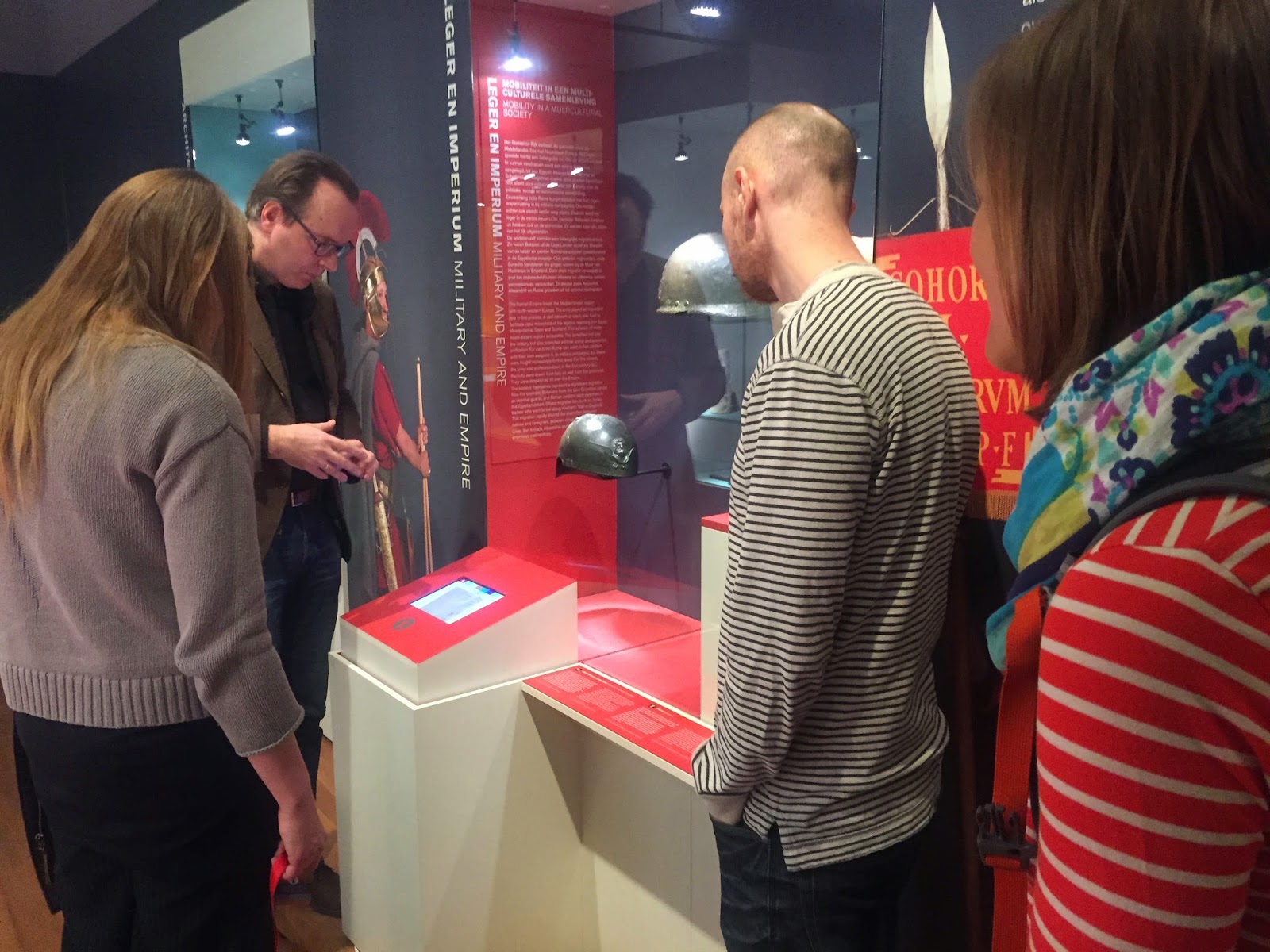
Visiting the Keys to Rome exhibition
at the Allard Pearson Museum.

For about a month ago, ARKDIS project was visiting colleagues in the Netherlands during a five day study trip to Amsterdam, Leiden and the Hague. The trip gave us a good idea of some of the current state-of-the-art in Dutch archaeology, archaeological presentation and information management.

At Allard Pearson Museum of the University of Amsterdam we were hosted by Dr. Wim Hupperetz who took us around at the museum and introduced us to their work on ArchaeoHotspots, a room where archaeologists and volunteers actually do archaeological research and work with finds in the museum, and where the public can come, watch and discuss.

At DANS, the Data archive and networking services, the Dutch data archive that preserves digital archaeological research data in the Hague, Hella Hollander and her colleagues presented their work and current state of the affairs in the archaeological information management in the Netherlands. In comparison to many other countries, including Sweden, the clear mandate of an organisation with a similarly clear focus on archaeological research for both preserving and making available digital archaeological data is an apparent advantage in the Netherlands.

At Europeana in the Hague, Joris Pekel hosted us and gave us a good overview of their work and highlighted the new strategy to focus on quality and partnership-based content production instead of attempting to incorporate as large quantities of content as possible.

We visited also the Faculty of Archaeology (yes, a faculty not a department) in Leiden and discussed with Dr. Hans Kamermans on education and research and the Vrije universiteit Amsterdam where Dr. Philip Verhagen and his colleagues presented their research and we had an opportunity to give a glimpse of the on-going work in ARKDIS. As a final stop, we visited the e-humanities unit of the Royal Dutch Academy of Sciences where Prof. Sally Wyatt hosted us and told about the e-humanities work in the country. We had also an opportunity to participate their weekly seminar, this time with a guest preseentation of Joseph Tennis from the University of Washington iSchool.

In addition to the common programme, all of us had an opportunity for additional visits to museums and

måndag 12 maj 2014

Archiving archaeology: Preliminary observations from a stakeholder study

The question of archiving, preserving and providing access to the outcomes of archaeological investigations has received more and more interest during the past decade. Considerable investments have been made in creating technologies, infrastructures and standards for digitalisation, preservation and dissemination of archaeological heritage. In contrast to the technical and infrastructural work, there is very little in-depth empirical research on the consequences, opportunities and implications of digitalisation to archaeological work, the emergence of archaeological knowledge and how it is used by diverse stakeholder groups of archaeological archives.

To gather empirical evidence, I conducted a study of the Swedish stakeholders of archaeological archiving has been conducted under the auspices of the ARKDIS project. A preliminary analysis of the interview records (N=16) of professionals working with archaeological archiving show that there are multiple technical, legislative, conceptual and structural problems that complicate the building, management and use of archaeological archives. The interviewees were chosen on the basis of a combination of selective sampling and snowballing (letting informants to indicate new possible informants).

Perhaps the most pressing problem discussed by all interviewees was the complexity of how  archaeological archiving is organised in Sweden. Archaeological heritage management and fieldwork involves a large number of actors and especially when it come to the management of digital information and primary research data, the responsibilities between different actors including the National Heritage Board, county administrative boards, archaeology contractors and the national and regional museums are not clearly defined. In practice, many actors keep large archives of data and documents and are waiting for someone to tell them what to do with them. A simpler process with clearer responsibilities would undoubtedly make a significant contribution to improving the general situation.

The complexity of the process has another consequence. At the moment, many actors are forced to work in relative silos. It is difficult to know what other stakeholders are doing with the produced documentation and what would be their actual information needs. From this perspective, it would be important to take carefully into account the needs of contractors, different types of researchers, research data curators, regional and national heritage administrators, archivists, finds managers and other stakeholders in the society when revising and developing the archiving and information process in Swedish archaeology. It seems that a shared and more tangible idea of the products and outcomes of archaeological operations and information  together with a clearer idea of customerships (i.e. who needs the information we are producing and how we can provide more meaningful information for other stakeholders) and supply-chain management (the process of producing, managing and using archaeological information in the society) could form a basis for a more robust and meaningful information production, management and archiving process.

In developing this understanding, it seems also relevant to put a special emphasis on how the different institutions and actors are working in practice with the production and management of archaeological information. A certain abstract consensus of the importance of documenting and preserving archaeological information and its significance aspects was shared by all informants, but when the discussion shifted to the everyday practicalities of working with archiving archaeology, the abstract consensus tended to turn to a broad range of not always entirely compatible practices. A finds administrator put specific emphasis on the management of finds, contractor to the practicalities of field work and an archivists on the details of the administrative process in ways that do not necessarily end up in a consistent corpus of records.

These highly preliminary first observations of the interview data will be complemented in the near future and reported in formal and more detailed publications in the near future. Slides and an abstract of a presentation held at the CAA 2014 conference can be found on the web.